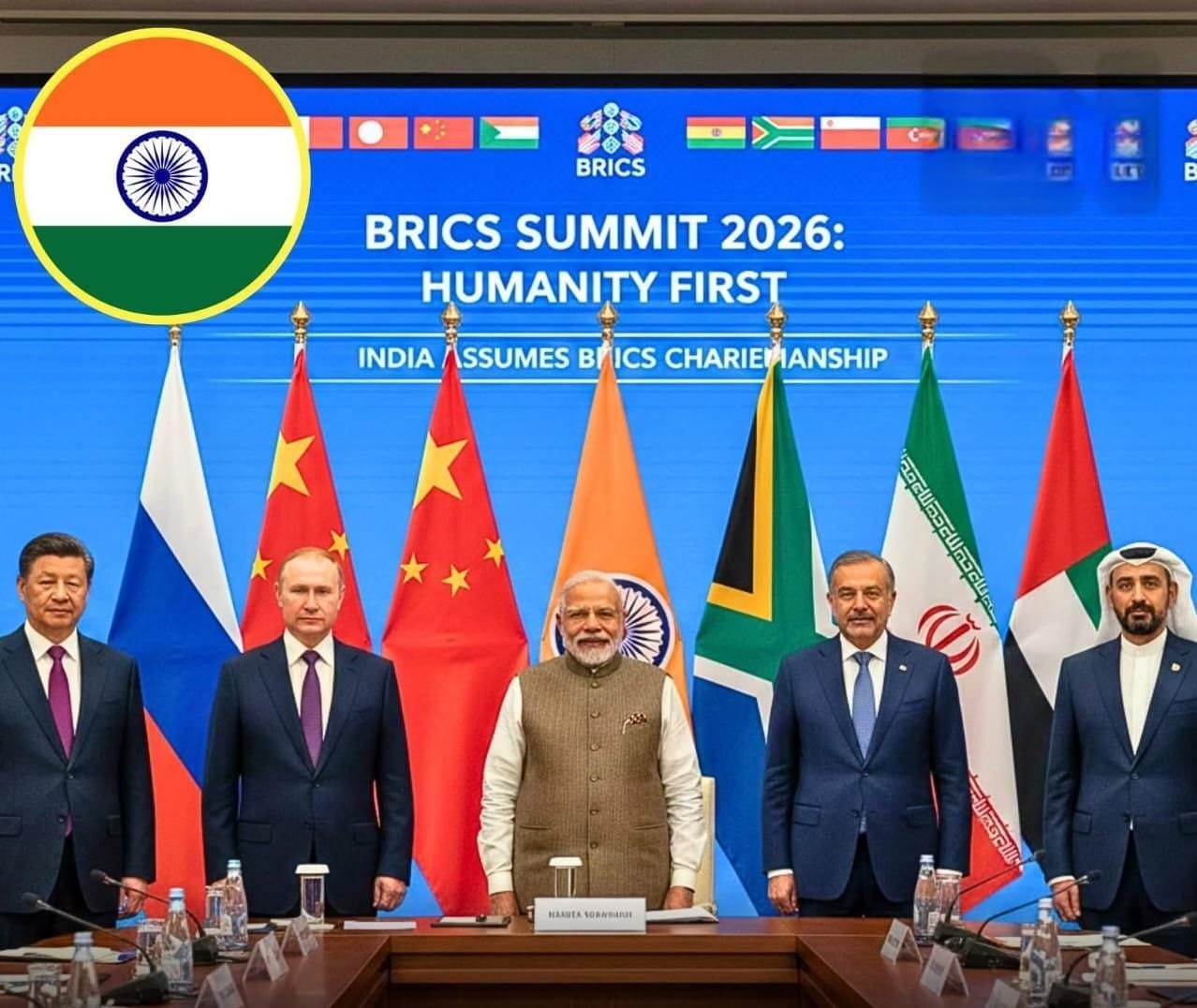
The 18th BRICS Summit was held in New Delhi from September 12 to 13, 2026, hosted by India under Prime Minister Narendra Modi's chairship at the Bharat Mandapam venue. The gathering brought together leaders from the eleven-member bloc, including China's Xi Jinping, Russia's Vladimir Putin, and representatives from Brazil, Egypt, Ethiopia, Indonesia, Iran, South Africa, UAE, and Saudi Arabia. The summit's theme was "Building for Resilience, Innovation, Cooperation and Sustainability," reflecting India's broader vision for the Global South. As the summit concluded, India's chairship for 2026 came to an end, with China taking over as BRICS chair for 2027.
The most significant outcome of the summit was the unanimous adoption of the New Delhi Declaration on the very first day, a notable achievement given the underlying divisions among member states over conflicts in West Asia and Ukraine. On the Middle East, the declaration called for immediate restraint and calm, and backed a two-state solution for Israel and Palestine while opposing the forced displacement of Palestinians. However, it carefully avoided directly condemning the US-Israeli strikes or Iran's targeting of Gulf countries, reflecting the bloc's effort to balance competing interests among its members.
On the Ukraine war, the declaration steered clear of naming either Russia or Ukraine specifically, instead issuing a general call for resolving international disputes through dialogue, consultation, and diplomacy. That said, the leaders did take a clear stance against unilateral sanctions not authorized by the UN Security Council, describing them as unlawful measures that undermine international law and the principles of the UN Charter. This was widely interpreted as an indirect criticism of Western sanctions imposed on Russia.
On the economic front, the declaration criticized the ongoing global trade war without explicitly naming the United States, and leaders separately emphasized the need to keep global trade, supply chains, and energy markets running smoothly despite geopolitical friction and Western sanctions. There was also a strong push among member states toward reducing reliance on the US, reinforcing BRICS' long-term goal of promoting a more multipolar global economic order. Beyond geopolitics and trade, the declaration addressed a wide range of other priorities, including reform of the United Nations and global governance institutions, international finance, energy security, food security, artificial intelligence governance, and sustainable development.
Alongside the formal proceedings, the summit featured a series of diplomatic engagements, with Modi holding multiple bilateral meetings and External Affairs Minister S. Jaishankar meeting Saudi Arabia's Foreign Minister Prince Faisal bin Farhan. The event also included softer diplomatic touches such as a leaders' family photograph, a joint tree-planting ceremony, a gala dinner hosted by Modi, and a "Bharat Innovates" exposition showcasing India's technological and cultural achievements. Overall, the summit demonstrated that while BRICS nations could unite around a shared text, the language on the most contentious geopolitical issues remained deliberately vague to accommodate internal disagreements, whereas the bloc spoke with much greater clarity and unity when criticizing Western trade policies and sanctions.
Leave a Comment